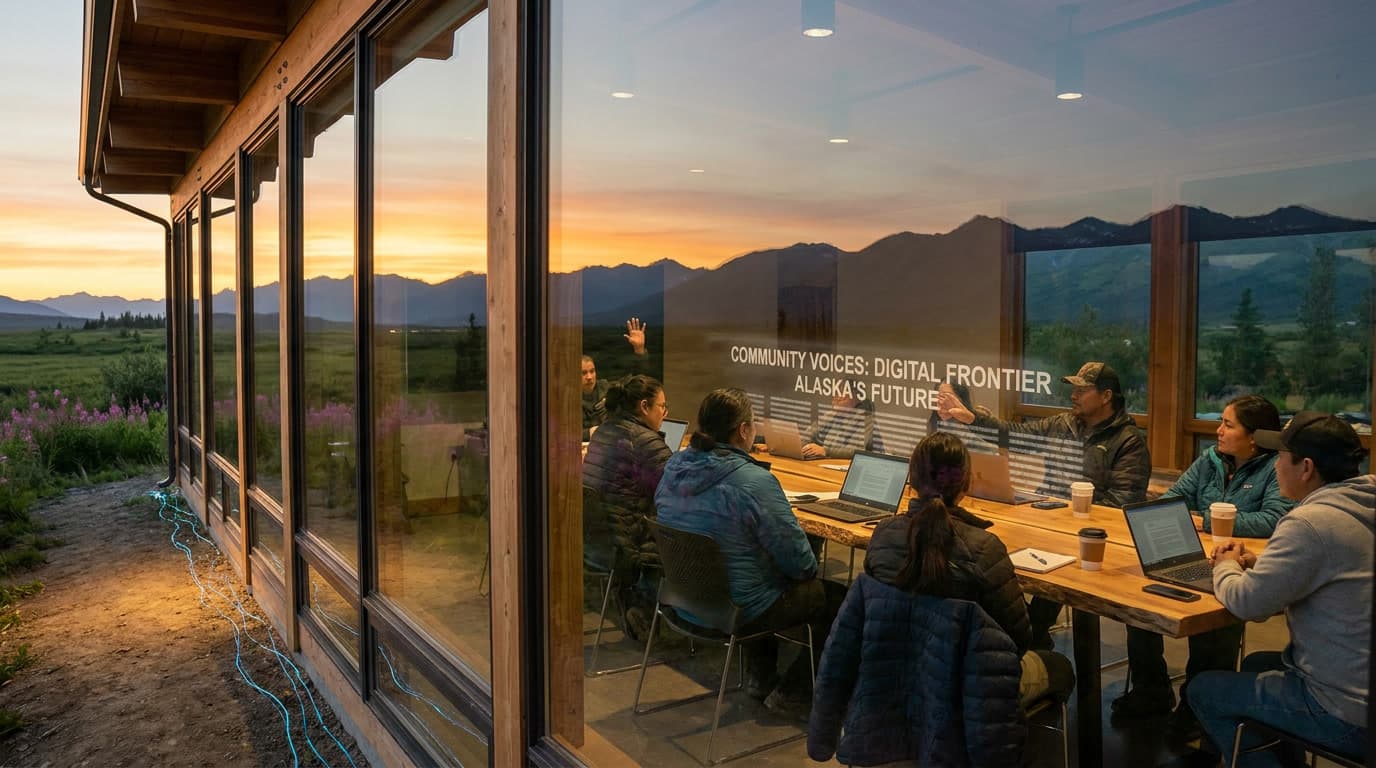
For your community
The platform is designed to expand. If your community has a newsroom-shaped hole (a public-meeting cadence nobody covers, a civic information vacuum, a legacy outlet that closed or hollowed out), there is a real path to bringing a Communities News newsroom to where you are.
This page describes what that looks like.
What the platform provides
When a new community comes online, it inherits the operational pipeline that powers Alaska News today.
- The audio-to-article pipeline. Public-meeting video gets transcribed, speakers get identified against your community's speaker registry, articles get drafted against verified evidence pools, and editorial review gates publication. The eight-stage pipeline described in How it works runs the same way for your meetings as it does for ours.
- Compute infrastructure. Volunteer computers process the audio. Volunteers can opt in to your community specifically, so a school-board meeting in your town is processed by a machine in your town when possible.
- Editor and contributor tooling. The same web app that Alaska News editors and citizen journalists use today. Editorial review queues, attribution validators, document enrichment, AI review, the whole production interface.
- Reader experience. A reader-facing site at your community's domain. No paywall. Free signup for following topics, locations, and speakers. Reader credits flow directly to the journalists whose work readers value.
- Brand and identity. A community-scoped domain (
yourcommunitynews.newsor similar), an editorial identity for your community, optionally an AI assistant agent named for your community's journalism tradition. - Operational support. Help with the meetings to onboard, the speaker registry to seed, the document sources to wire up, and the rollout cadence.
What you provide
The platform is infrastructure, not a complete newsroom.
The newsroom is the people running it locally. Specifically:
- Editorial leadership. A real editor or editorial team that reviews every article before publication and owns the editorial decisions. The platform does not publish without human review, by design. That human is yours, not ours.
- A small base of citizen journalists. Contributors who know the community, write against AI-generated drafts, get peer reviewed, and earn credit when readers value their work. Two to ten contributors at launch, growing from there.
- Local context. The speakers who matter, the meetings worth covering, the institutions that produce records, the stories worth following. The platform amplifies local knowledge; it does not replace it.
- Compute volunteers in your community. A handful of people willing to dedicate idle computer time to processing local meetings. We help recruit; the relationships are local.
- A funding model that fits your community. Reader credits, foundation support, civic partnerships, or a combination. Different communities work differently. We share what we have learned in Alaska and help you adapt.
What this is not
It is worth being explicit about what we do not do, because the standard "AI for local news" pitch can blur it.
- We do not run your newsroom. Editorial decisions stay with the local team. We provide tooling. The judgment is yours.
- We do not replace journalists. A community without a serious editor and at least a small contributor base is not ready to launch. The AI does the structural work; the humans do the journalism.
- We do not promise nationwide coverage from one button. Each community is a real onboarding: meetings to identify, sources to wire up, registries to seed, contributors to recruit. Expect weeks of setup, not minutes.
- We do not work for every community. Communities with no public-meeting cadence, no internet access, or no human willing to take editorial responsibility are not a fit. We will tell you honestly if we think your community is not ready.
What it costs
We are still learning the right shape here, and we are deliberate about not having a self-serve price page until we know it. A first conversation is free. A pilot in a single community can be scoped against foundation, partnership, or platform-fee structures depending on what fits. Cost per published story falls by an order of magnitude relative to legacy newsroom economics; what that translates to in dollars depends on how the funding model is shaped.
How to start
Send us a note. Tell us about your community: how big it is, what its public-meeting cadence looks like, who is on the editorial team you have or could assemble, what is currently failing about the local-news situation. We will reply with a real assessment of fit, not a sales pitch.
Or read more about the architecture: How it works